Blog
Mastering Voice-Over Scripts

Understanding the Script
A professional voice-over artist does not simply read what is written. They understand the thought, intention and emotion behind the words—and make the listener hear it.
Understanding and interpreting a script is one of the most important parts of professional voice-over work, yet it is often overlooked because the finished performance makes it appear effortless. A script may arrive as nothing more than a document filled with sentences, punctuation and paragraphs, but the voice artist’s responsibility is to transform that written material into communication. Before the microphone is switched on, the performer must understand what is being said, why it is being said, who is meant to hear it, and what the listener should take away from it. The words on the page are only the starting point. The real performance begins when the artist discovers the thinking behind those words.
In professional voice-over, I have always found that one of the biggest differences between simply reading a script and delivering a convincing performance is the ability to think beyond the words. A sentence can be pronounced perfectly and still sound completely wrong. The grammar can be flawless, the pacing technically controlled and every word accurately articulated, yet the recording can feel lifeless because the performer has not connected with the thought. The listener may hear the words, but they do not hear a person communicating. That distinction is critical. Voice-over is ultimately not about producing sound from written text; it is about taking an idea that exists on a page and transferring that idea naturally into another person’s mind.
This is why I approach a script first as a piece of communication rather than as something to be read. Before worrying about where to pause or which word to emphasize, I want to understand what the speaker is actually trying to accomplish. Is the speaker explaining something? Selling something? Building confidence? Introducing an idea? Creating urgency? Telling a story? Reassuring the audience? Establishing authority? Creating curiosity? Those intentions determine how the words should live in the voice. The same sentence can be delivered with warmth, authority, excitement, concern, humour or restraint depending on the circumstances surrounding it. There is no single correct way to read a sentence until you understand the reason the sentence exists.
This becomes particularly important when working on corporate films, commercials, documentaries, educational content and branded storytelling. A corporate narration, for example, may contain language that appears straightforward: growth, innovation, leadership, technology, transformation and opportunity. If those words are simply read one after another with equal emphasis, the result can become predictable and corporate in the worst sense of the word. The professional voice artist has to find the human idea underneath the corporate language. What does “innovation” actually mean in this particular story? Why should the audience care about the company’s growth? What does the transformation represent? Once those questions are answered, the delivery becomes more purposeful. You are no longer saying words because they appear on the page; you are communicating an idea that you understand.
The difference between reading and speaking becomes especially obvious when an experienced speaker is handed a script. Someone may be naturally charismatic in conversation, able to explain an idea with energy and personality, but the moment a page is placed in front of them, that natural communication can disappear. Their eyes begin following individual words instead of following the thought. They start anticipating the next sentence instead of finishing the current idea. Their breathing changes, their rhythm becomes predictable and their voice begins to sound like it is performing a task. This is one of the reasons professional voice-over requires more than a good voice. The artist has to maintain the mental process of conversation while simultaneously respecting the written structure of the script.
I often think of the microphone as simply another person in the room. It does not change the fundamental responsibility of communication. If you were explaining something important to someone sitting directly in front of you, you would not normally give every sentence the same weight. You would react to your own thoughts as you speak. You would slow down when an idea becomes important, move more quickly through information that is already understood, pause when you want the other person to absorb something, and change your energy when the subject changes. Good voice-over should retain that same sense of human thought. The microphone should capture a conversation, not expose the fact that someone is reading.
Script interpretation becomes even more demanding when the material is technical, scientific, medical or highly specialised. In those situations, there can be a temptation to focus almost entirely on terminology. The performer encounters an unfamiliar word, spends time learning how to pronounce it and then concentrates on delivering that word correctly. Accurate pronunciation is essential, but it is only one part of the job. I want to understand what the terminology is doing within the sentence and what is happening within the larger explanation. If the script describes a process, I need to understand the process. If something is moving, changing, increasing, decreasing, combining or separating, I need to understand that movement. Even when I cannot become an expert in the subject in the limited time available, I can understand enough of the context to avoid delivering the information as a collection of disconnected technical terms.
That distinction matters because the listener may know nothing about the subject. In technical and educational voice-over, the artist often becomes the guide through unfamiliar information. The delivery has to give the listener confidence that the information can be understood. A complex sentence may require patience. A key concept may need subtle emphasis. A transition may need enough space for the listener to follow the progression of the explanation. None of this necessarily requires dramatic acting. In fact, overacting can make technical narration less effective. What matters is clarity, confidence, control and an understanding of the information being communicated.
The same principle applies to pronunciation. When I encounter an unfamiliar name, place, organisation, medical term or technical expression, I do not believe in guessing simply because the word looks familiar. A professional recording leaves very little room for assumptions. Pronunciation should be verified, particularly when the word is central to the project or when an incorrect pronunciation could undermine the credibility of the narration. But pronunciation should never become an isolated exercise. Knowing how to pronounce a word does not automatically tell you how that word should be delivered. You still need to understand its meaning, its importance within the sentence and its relationship to everything around it. Accuracy and interpretation have to work together.
Another important part of script preparation is reading the entire piece before recording. I do not like discovering the story sentence by sentence while the microphone is running. The performer should know where the script is going. A line near the beginning may appear neutral until you understand what it leads to several paragraphs later. A sentence that initially seems to require energy may actually need restraint because the story is building toward something more significant. Understanding the complete script gives the performer a sense of direction. You begin to understand its rhythm as a whole rather than treating every sentence as an isolated unit.
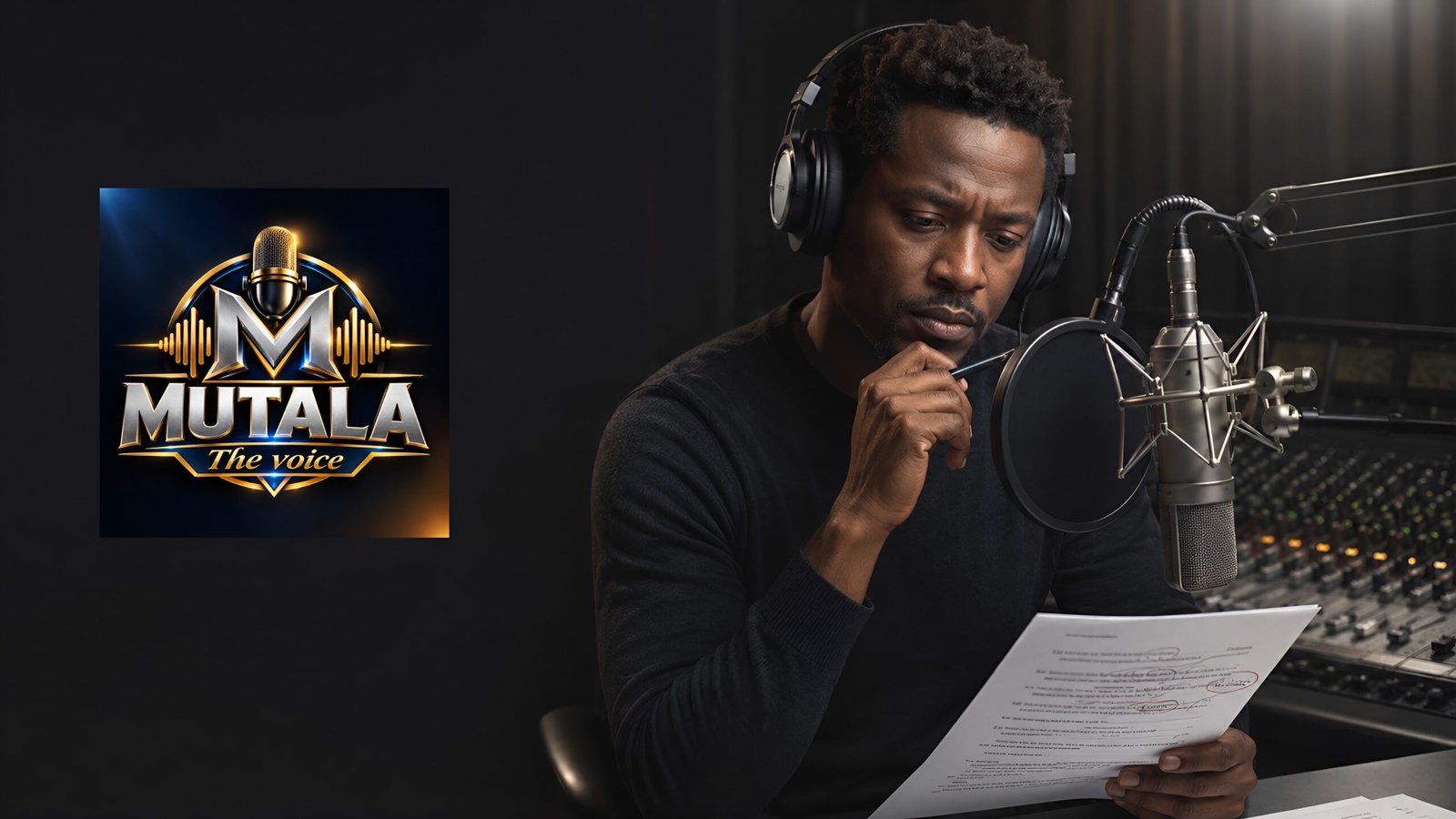
This is also where script marking becomes useful. Marking a script is not about covering the page with symbols until it becomes impossible to read. It is about creating a simple visual map of your interpretation. Important words can be identified. Natural thought breaks can be marked. Difficult pronunciations can be noted. Sections that require a change in energy can be highlighted. Long sentences can be studied for their internal structure. The purpose is to reduce the amount of interpretation you have to perform for the first time while recording. When you step up to the microphone, your attention should be available for communication, not consumed by figuring out what the sentence means.
Punctuation also deserves careful attention, but it should never be allowed to dictate the performance mechanically. A comma does not automatically mean you must take a breath. A full stop does not necessarily mean the thought has completely ended. Written punctuation exists primarily to organise language on a page, while spoken communication has its own rhythm. Sometimes a thought continues naturally across a punctuation mark. Sometimes a strategically placed pause before the end of a sentence creates more meaning than the punctuation suggests. The voice artist has to interpret the writing rather than become a prisoner of it.
This is one of the reasons listening is such an important professional skill. You need to listen not only to other voice artists but also to ordinary human conversation. Pay attention to how people actually communicate when they are explaining something they care about. Notice how their voices change when they remember something, become uncertain, want to persuade someone or realise that the other person has misunderstood them. Listen to where they pause and where they accelerate. Notice that emphasis is rarely created simply by speaking louder. Sometimes the most important word in a sentence is delivered more quietly, more slowly or with greater intention.
That observation of real human communication is invaluable because the listener is not expecting to hear a textbook. They are expecting to hear a human being. Even highly polished commercial and corporate voice-over should retain some sense of natural thought. Professional does not mean emotionless. Authoritative does not mean stiff. Conversational does not mean careless. Warm does not mean overly familiar. The artist’s skill is knowing where the appropriate balance lies for the particular project.
One of the most useful questions I ask when approaching a script is simple: Who am I talking to? Not “What demographic is this?” and not simply “Who is the target audience?” I mean, who is the individual person on the other side of the message? If I am narrating an educational video, I imagine someone genuinely trying to understand the subject. If I am recording a corporate film, I imagine someone deciding whether they can trust the organisation. If I am recording a commercial, I imagine someone whose attention has to be earned before the message can even begin to persuade them. Once the listener becomes real in your mind, the delivery starts to change.
Another question follows naturally: Why does this person need to hear this? That question can completely change the performance. If the answer is to inform, clarity becomes central. If the answer is to persuade, the delivery needs conviction without sounding forced. If the purpose is to inspire, the voice needs room to breathe and build. If the purpose is to reassure, control and warmth may matter more than energy. Understanding the purpose gives the voice somewhere to go.
This is why I believe the best voice-over performances are created before recording begins. The microphone does not create interpretation. It captures it. If the artist steps into the studio without understanding the script, better equipment will not solve the problem. A more expensive microphone cannot give meaning to a sentence that the performer has not understood. Technical quality can make a recording cleaner, but it cannot make an empty performance meaningful.
There is also a danger in trying too hard to sound like a “voice-over artist.” Beginners often believe professionalism means lowering the voice, exaggerating diction, adding unnecessary drama or adopting a style they have heard from another performer. That approach can produce a voice that sounds like a voice-over, but not necessarily one that communicates. Your responsibility is not to sound impressive. Your responsibility is to make the message believable. Sometimes that means authority. Sometimes it means intimacy. Sometimes it means energy. Sometimes it means almost getting out of the way and allowing the words to speak for themselves.
Ultimately, interpreting a script is an exercise in intention. You are constantly asking what the writer means, what the speaker wants, what the listener needs and how the message should travel from one person to another. You are looking for the thought underneath the sentence, the emotion underneath the thought and the purpose underneath the emotion. Once you understand those layers, your technical decisions—pace, pitch, emphasis, pauses, breath and energy—begin to make sense.
The script is therefore not the finished performance. It is the blueprint. The words provide the structure, but the voice artist provides the human interpretation that allows that structure to live. A professional does not simply ask, “How do I read this?” The better question is, “What am I trying to make the listener understand, feel or believe?”
That is the difference between reading words and communicating a message.
In professional voice-over, your greatest instrument is not simply the voice you bring to the microphone. It is the understanding you bring to the script. When you understand the thought, you can communicate it. When you understand the intention, you can deliver it with purpose. And when the listener no longer hears someone reading from a page but feels that someone is genuinely speaking to them, the script has finally become a voice.